What's Left for Humans? A Roundtable on Purpose in the Age of AI
By Karthik Nagapuri · 2026-01-13
TLDR;
When AI surpasses humans at nearly everything, we explored what remains: the care economy, entertainment, artisanal crafts, and roles requiring human connection. The uncomfortable truth? Only a tiny fraction might find economically valuable work. States may become more important for UBI distribution, not less. The real question isn't about jobs but about meaning and identity when intelligence is no longer uniquely human. We left without answers, but with one insight: in the age of AI, the human story behind something matters more than ever, precisely because we're imperfect.
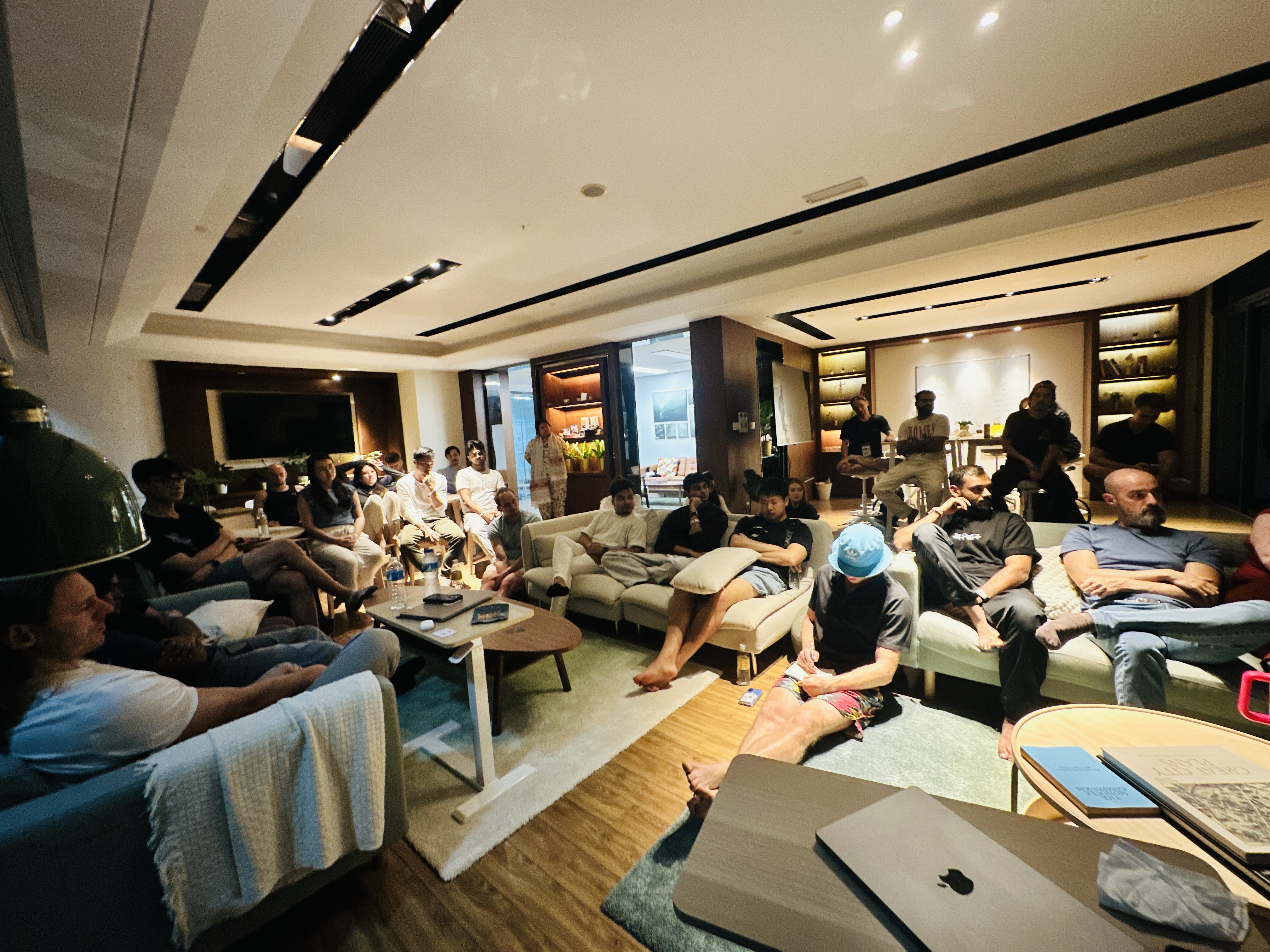
On January 12th, 2025, at 8 PM, James hosted over 40+ people from across the globe at Arc Lounge at Network School for a conversation that everyone want to elarn from others perspcectives. For an hour, founders, AI researchers, musicians, physicians, roboticists, artists, and community builders from Network School more than a dozen fields wrestled with an impossible question:
When AI can do everything we can do, only better, faster, and cheaper, what's left for us?
We sat somewhere between East and West, both geographically and philosophically, a diverse group of thinkers confronting our collective future. Nobody had good answers. But the conversation itself revealed something important about what it means to be human in the first place.
Chess Players and Wrong Notes
The discussion opened with a paradox. AI has been crushing humans at chess since 1997, that's 28 years now, when IBM's Deep Blue defeated world champion Garry Kasparov. Yet chess has never been more popular. More people play it, more people watch it, more people pay for it.
"We don't actually care for some things that AI is better than us at," someone observed. "We have no interest in if AI can do it well. We care about whether humans do something well."
A musician in the group pushed this further: "I went back to a Nirvana concert video where I saw, you know, the guitarist playing, like, seven consecutive wrong notes, but, you know, everyone was still enjoying. Because they wanted to see a human perform something."
That hit different. The imperfection wasn't a bug, it was the whole point. We connect with the struggle, the uncertainty, the very real possibility that it might all fall apart. An AI playing perfect music is just noise. A human playing seven wrong notes? That's a story.
"AI music is, like, way too perfect," the musician continued. "Human beings connect with each other when there's a real human performer. People would like to go and watch instead of, like, streaming music online."
A physician shared how this plays out in medicine: "Since I started implementing AI across all facets of my practice, I got a lot more fun. It's just far more enjoyable. Now I kinda feel like Tony Stark with Jarvis." The AI handles documentation, calculations, data analysis through tools like Tally AI. "Now I'm just more present. Compassionate."
But then he added something that cut to the heart of it: "I think my job will be fully replaced, which is great. I don't think humans are necessary in that loop."
Wait, what?
The Scale Problem Nobody Wants to Face
The optimism in the room kept running into a brick wall: math.
"We're walking into this thinking everybody will become like a musician or an artist," one person said bluntly. "But I can't create music for shit. I don't think that capability would increase. So my point is the sense of scale might be something that we are underestimating."
How many professional chess players can the world support? A few hundred? How many artisan watchmakers? How many world-class musicians? Even if we accept that humans will still value human-made things, we're talking about a tiny percentage of the population who could actually make a living that way.
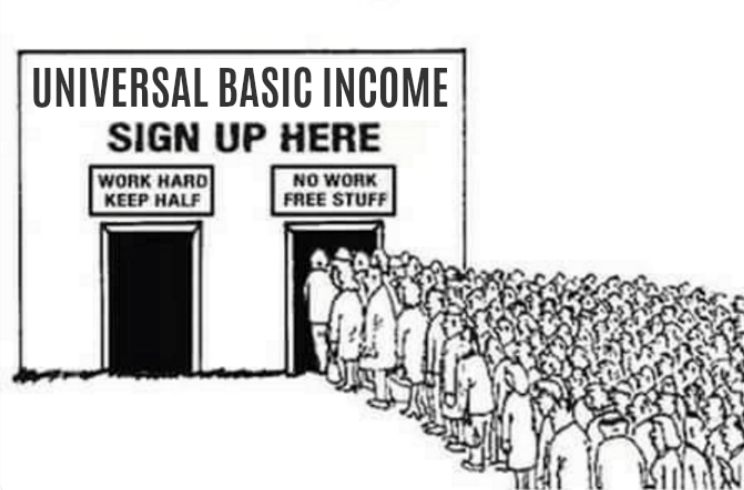
Someone threw out the obvious answer: Universal Basic Income.
"I don't think humans can just exist to have a good time," another person pushed back. "We as humanity, we cannot survive. We do not have time to just sit on a beach and have conversations. Human beings thrive on waking up tomorrow and doing something that is not done yet. We need work to have some sort of meaning in life."
And then there's the resource problem. "We are already overconsuming everything," someone noted. The current world population is around 8.2 billion people. "So if we are talking about everyone owning something, that is absolutely not possible. In future, I believe either there will be a population drop because of survival of the fittest."
Even in a world of AI-generated abundance, abundance isn't free. It requires energy, water, rare earth minerals, physical space. All finite. All increasingly contested.
What Might Actually Be Left
Through the fog of uncertainty, a few categories of potentially valuable human work emerged:
The Care Roles: Healthcare where you want a human present. Education where personal connection matters. Community building. Therapy. Judicial decisions. As the physician put it, he's finally able to focus on what he entered medicine for in the first place: being present and compassionate with patients. "If I am more there for a human touch and compassionate role, I think that's actually what I went into the practice to do to begin with."
Performance and Entertainment: Not just musicians, but athletes, comedians, anyone whose performance is enhanced by the possibility of failure. "If you have a goalkeeper that just always saves, what's the point of taking the penalty?" someone asked. Exactly. The uncertainty is the product.
Someone else elaborated: "Anything and everything that feeds on the fact that the output is ambiguous. Sports, for example. The reason I watched a chess match between Magnus and Gukesh is because there's a young guy facing an end time world champion, this tension. There's time being spent. There's energy. There's sweat. And there's stories."
Artisanal Craftsmanship: One person suggested that human-made watches might become exponentially more expensive than AI-made equivalents, precisely because a human made them. "I think the rich will have their homes full of products made by humans, precisely because they are extremely expensive versus the AI ones. The human-made watch should theoretically become way more expensive relative to the exact same product next to it."
Human Touch and Community: Yoga teachers, community organizers, facilitators. "Human beings will always be in a community, and we'll try to have a human touch," a community builder emphasized. "People like to make mistakes and they love to live with the people only, not robots. For facilitating those societies and communities, and creating those circles in the future, you could get monetized to be part of the circles."
Curation and Taste: Someone suggested humans might get paid to "put our human social credibility behind something. So if, like, I say something is cool, like, it wasn't the robot that said it, it's literally the human. So you could pay people to canvas them for their human opinions."
Ownership (Maybe?): Humans might remain shareholders and decision-makers even if AI does all the operational work. Though as one person wondered aloud: "What is left of ownership when the only thing you get to make decisions about is capital allocation? If you don't care about competency, or at least there's an AI that is more competent than you at doing the ownership decisions, what is left of ownership?"
The Part Nobody Wanted to Say Out Loud
The most honest moment came when someone asked: "Will we become pets of a higher species that we created ourselves? AI will take care of us. They'll do all the relevant stuff. And we will be doing, like, having fun and decorating your cake or whatever."
Nobody answered directly. But the question hung there.
Another person tried to find hope in inner exploration: "We're very young in terms of how much we've explored thought. We're, like, extremely young in terms of how much we've explored feeling. There's, like, an infinite world. We've gone really far in terms of what we can do on the outside and what we've discovered. But I think we're very young in terms of what we've discovered on the inside."
Maybe AI's dominance of the external world will finally force us inward, to explore consciousness and human subjective experience. But even that felt like rationalization. Like something you tell yourself when you've already lost.
States and the UBI Question
Here's where it got really dark.
James argued that nation-states might become more important in the coming century, not less. Why? Because states will control the boundaries of UBI distribution.
"Your state is gonna set the boundary for UBI," he explained. "There's gonna have to be some sort of system where it coerces a model company, that it taxes them, extracts resources, which is then able to pay out the rest of them. And you being in a state that has a good ratio of taxable models to citizens and mouths that need feeding largely determines the quality of life that you're gonna be living."
Think about that. The accident of where you're born determines whether you live in abundance or scarcity. And states might restrict mobility to prevent human capital flight.
"I don't think the mobility that we enjoy even now would be something that'll be common," someone warned. "Because then you don't want human resources to move around, especially with capital."
"The transition period is the problem," someone else said. Not the distant AGI future, but the next ten years, when mass unemployment hits before social safety nets exist. "If you are living in a place where people don't really understand the technology, that you have a huge population, you can have a civil war inside. That's why I agree that it's going to be really important for you to choose the place you are going to be."
Resource wars. AI arms races between nations. A scramble for compute, for energy, for any advantage. Multiple people discussed whether AI lab companies and governments would remain separate entities, or if governments would capture the labs, or if the labs themselves would become governing bodies.
"Why do they give us certain resources?" someone asked, referring to whoever ends up in power. "Like, why they share with us? I don't know. It's scary."
The Question We're Really Asking
Underneath all the practical concerns about jobs and UBI and resources, there's a deeper question nobody wanted to articulate directly:
What does it mean to be human when our defining characteristic, our intelligence, is no longer unique or valuable?
One person captured it perfectly: "I think we're going to have space to heal. We're constantly facing noise and survival. And I think once that's taken away, we're gonna be faced with ourselves in an existential way that we haven't before. Kind of like when someone gets a terminal diagnosis, you start seeing life completely differently."
Like getting a terminal diagnosis. Suddenly you see your neighborhood differently. Your relationships. The time you have left. Everything shifts.
"I think we're as a human race going to have this very shocking visceral experience of what it means to be human," they continued. "It's gonna redefine it to us. I think that's gonna have a massive wave in how we view reality, our purpose, and our relationships."
Another person brought up accountability: "Tomorrow, let's say that AI goes and we are dismantling everything. And something goes wrong. Who will be the one taking accountability for that? Because we as humans, if anything goes wrong, we are not gonna go and ask AI. You want a human to then take charge when something goes wrong and then take accountability."
One Thing We Know for Sure
If there was a throughline in the conversation, it was this: in the age of AI, the human behind something matters more than ever.
Not because humans are more capable. Precisely because we're not.
The imperfection, the story, the struggle, that becomes the point. We'll pay to watch humans do things, even when AI can do them perfectly,
because perfect is boring. Perfect has no story.
James captured it: "I think one of the things is that in the age of AI, the human has never mattered more. The person and the story behind anything that's happened. Which is interesting."
We might not be the best anymore. But we might be the most interesting.
No Resolution
The hour ended without answers because maybe none exist yet. We don't know if we're three years or thirty years from the scenarios we discussed. We don't know if AI will be centralized in a few hands or distributed across thousands of network states. We don't know if there will be abundance or scarcity, freedom or surveillance, meaning or drift.
As one person noted: "I think the question is too broad. We should maybe start with qualifying it from time frames to, okay, we're talking about 2026 or 2035 or 2050, because a lot of things change till then. Otherwise, the answer for most of it is that we don't know what's gonna happen."
What we do know: the question "what's left for humans?" can't be answered purely through economics. It's fundamentally about meaning, identity, and what we value about being human beyond productivity.
And maybe that's the real work ahead. Not figuring out what jobs will remain, but figuring out who we want to be when work is optional.
Though as multiple people reminded us: human beings can't just exist without purpose.
We need challenges. We need problems to solve. We need to wake up with something to do.
So maybe the work is deciding what work means when we no longer have to work to survive.
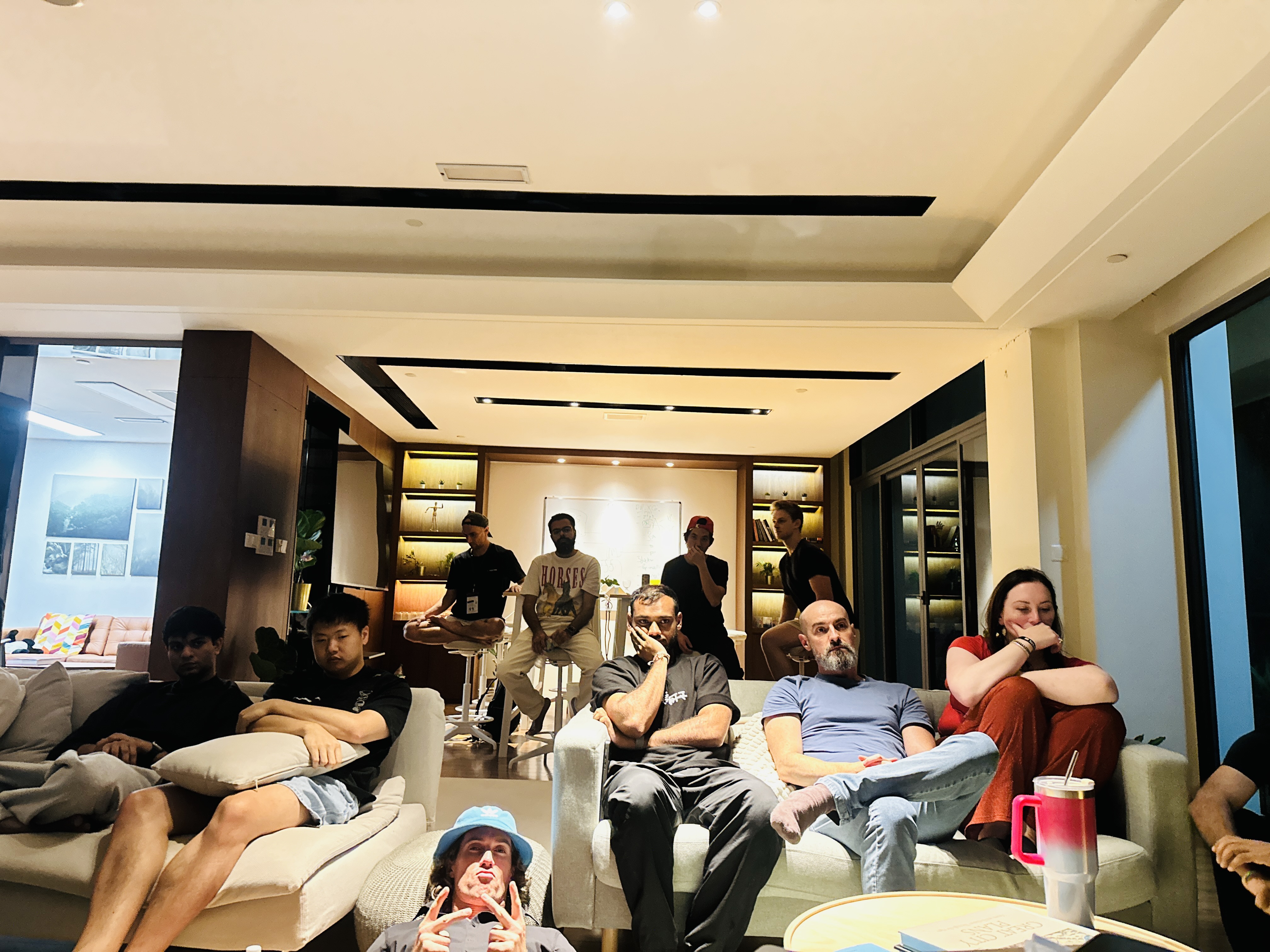
This conversation happened on January 12th, 2025, at Arc Lounge with over 40 participants from around the world in Forest City, Malaysia-Singapore, Earth