Day 2 · Validate the problem before the product
By Karthik Nagapuri · 2026-09-15 · Draper Founder Program #2
How to find out what is actually true about your market: Vishnu Chundi on pain × frequency × consequence, past-facing questions and the pre-mortem, then a panel with Srinivas Kollipara, Rathnakar Samavedam and G. Sravanth on niches, pivots, why now and what investors want proven.
Day 2 started at 7 am with a juggling session, which turned out to be the right warm-up for a day about holding too many balls at once. By 10:30 we were on the fifth floor with notebooks open, and by lunch I had rewritten the first page of our own pitch in my head twice. The day had two big blocks: a working session with Vishnu Chundi on defining the real problem and the riskiest assumption, and a fireside chat on market and "why now" with Srinivas Kollipara, Rathnakar Samavedam and G. Sravanth. It closed with Mafia Night, where I learned that founders are much better at accusing each other than at defending themselves, which is its own lesson.
If Day 1 was about how to tell your story, Day 2 was about whether the story is true. Everything here applies whether you are a student with a notebook of ideas, an operator who has spotted a gap at work, or a founder with a product already in pilots. In fact, the further along you are, the more it stings, because you have more you would rather not question.
The day's programme
The theme, as the organisers put it the night before, was "mapping the terrain": the real problem, the real market, no assumptions left unchecked. The sessions, as announced:
- 7:00–8:00 AM: Wellness session: juggling
- 10:30–11:30 AM: Workshop: Define the Real Problem and the Riskiest Assumption, with Vishnu Chundi
- 11:30 AM–1:00 PM: Fireside chat: Market and "Why Now", with Srinivas Kollipara, Rathnakar Samavedam and G. Sravanth
- 2:00–5:00 PM: 1:1 cabin sessions, plus an "ME session" with Srinivas Kollipara and Rathnakar Samavedam
- Late afternoon: a further session with SK of Draper University India
- 6:00–7:30 PM: Mafia Night, run with Peopld
The 1:1s were private, so this chapter covers the two morning sessions, which is where the frameworks were.
Treat your startup as a hypothesis
Vishnu introduced himself as the founder of a company that helps Indian families with wealth transfer: wills, trusts and legal heir certificates. He grew up in Hyderabad, worked in law and in the London fintech world, and turned founder during business school. He said up front that he wanted the hour to feel less like a lecture and more like a working session on our own startups, and he kept that promise.
His one-line summary of the session: how do you find out what is actually true about your market before you go too far into building more?
He asked how many of us had read The Lean Startup. Not many hands went up. He called it "almost like a Bible" and said the early chapters are basically about mapping the terrain before you commit. Then he gave us the frame that the rest of the morning hung on.
- Any startup, any company, is basically a hypothesis.
- So all of us are, in a way, scientists: we design experiments to find out whether the hypothesis is right.
- The difference is that we are not publishing papers. A company is a capitalistic entity. It has to solve a problem, create value and get paid.
- Which is why falling in love with the idea is dangerous. Fall in love with the company, because a company can pivot and hold many ideas, while a single idea limits your worldview.
The earlier you discover that an assumption is false, the faster you can change it. He admitted that part is obvious. The interesting part is how you discover it.
His deck, titled "Map the Terrain", made the same point with a pairing I have since stolen for my own notebook: a nineteenth-century general's line about war, set beside a startup teacher's line about customers.
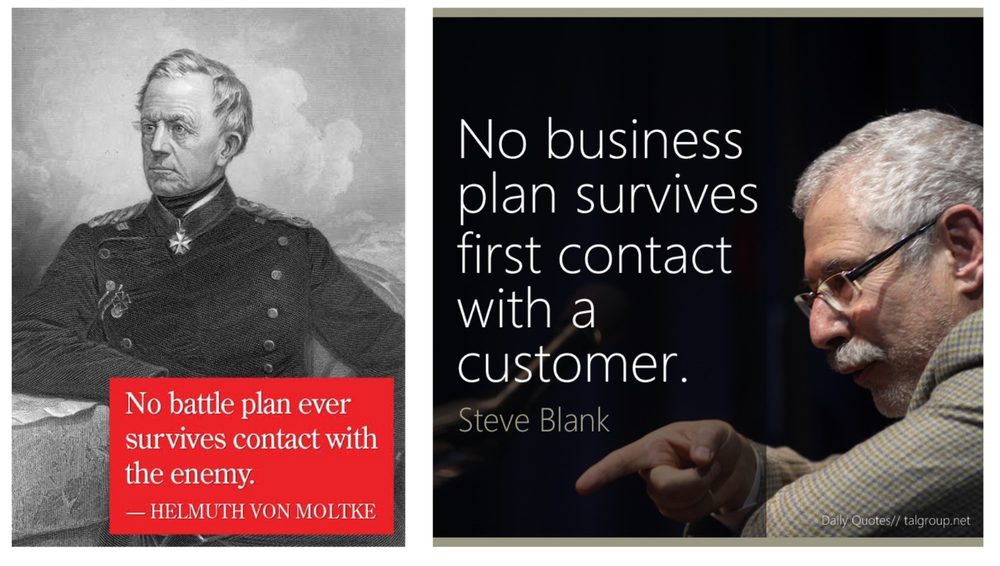
No business plan survives first contact with a customer.
- Steve Blank, quoted by Vishnu Chundi
The general was Helmuth von Moltke, whose version was that no battle plan survives contact with the enemy. Neither man was saying that plans are useless. They were saying that the plan is a set of guesses that the first real encounter will rewrite, so the smart move is to make that encounter happen early and cheaply, while rewriting is still easy. A business plan written before you have spoken to twenty customers is not a plan. It is a list of hypotheses in a nicer font.
Score the problem: pain × frequency × consequence
"Just because somebody has a problem does not necessarily mean it's an inconvenience," Vishnu said, and then told us about his cabs. He doesn't drive; he takes cabs everywhere around Hyderabad. Some of them are not clean, and he doesn't enjoy them. But for a 20 or 30 minute ride he puts up with it. It is a pain, but not enough of a pain for him to buy a car and hire a driver. If someone offered him a luxury car for three or five times the fare, he might happily pay. But that is a nice-to-have, not a must-solve.
So for every customer, he asked us to place the problem on a scale:
- 1 to 3, nice-to-have: "It would be lovely, but I'm not looking for a solution."
- Middle, annoying: it costs them something, but they have workarounds.
- 8 to 10, must-solve: severe enough that they are already spending money, time or energy on workarounds.
Then he added two more dimensions and multiplied them.
Frequency is how often the customer hits the problem. Economic consequence is whether solving it actually saves them money, time or risk. Because it is a product, one very high number can carry a moderate one. But a zero anywhere kills it. The factor most founders under-research, he said, is the third: the economic consequence of fixing it.
The real competitor is the status quo
He then went round the room and asked each company to score itself. We were among the first, and it is a good worked example of how the exercise humbles you. I started explaining the product and he stopped me, kindly: "Karthik, I think you're pitching the idea again. Ask the other person: who is the user?" Scored honestly from the user's side, we landed in the middle, around a 5 or 6. Annoying, real time loss, but people are managing. When he asked what they do instead, the answers came quickly: an extra junior employee, manual workflows, spreadsheets, WhatsApp groups.
So your real competition, at least at this stage, is the status quo. It's the inertia.
- Vishnu Chundi
This is the line I would put on every founder's wall. Most of us benchmark ourselves against other startups in our category. The real competitor, in most markets, is a cheap, familiar arrangement that already sort of works: a person, a register, a spreadsheet, a habit. That competitor is already hired, already trusted, and costs nothing to keep. To win, you have to show you are more effective, cheaper and more consequential than doing nothing new.
A few examples from any sector:
- A B2B invoicing tool is not competing with another invoicing tool. It is competing with the accountant who does it on a Saturday.
- A consumer fitness app is competing with "I'll just go for a walk".
- A logistics platform is competing with the dispatcher who has every driver's number in his phone.
Test top-down stories bottom-up
In our own scoring I made the case for the consequence with a top-down number: if the product improves one business metric by even a small amount, the value is large. Vishnu said he loved it "as a bite", because top-down pitches sound very nice. Then he took it apart gently, with three questions that apply to any "if we move this by 1%" argument:
- Is that improvement actually feasible?
- What are the second-order and third-order things that have to happen for it to be true?
- Who is the person that actually benefits? The user, the owner, the procurement department?
His advice was to verify every link in the chain bottom-up, with neutral people, not only the insider on your own team. A co-founder who has lived the problem gives you genuine insight, but insight from inside the team is still an opinion until it is tested outside it.
Ask about the past, not the future
This was the part of the morning I wrote down word for word.
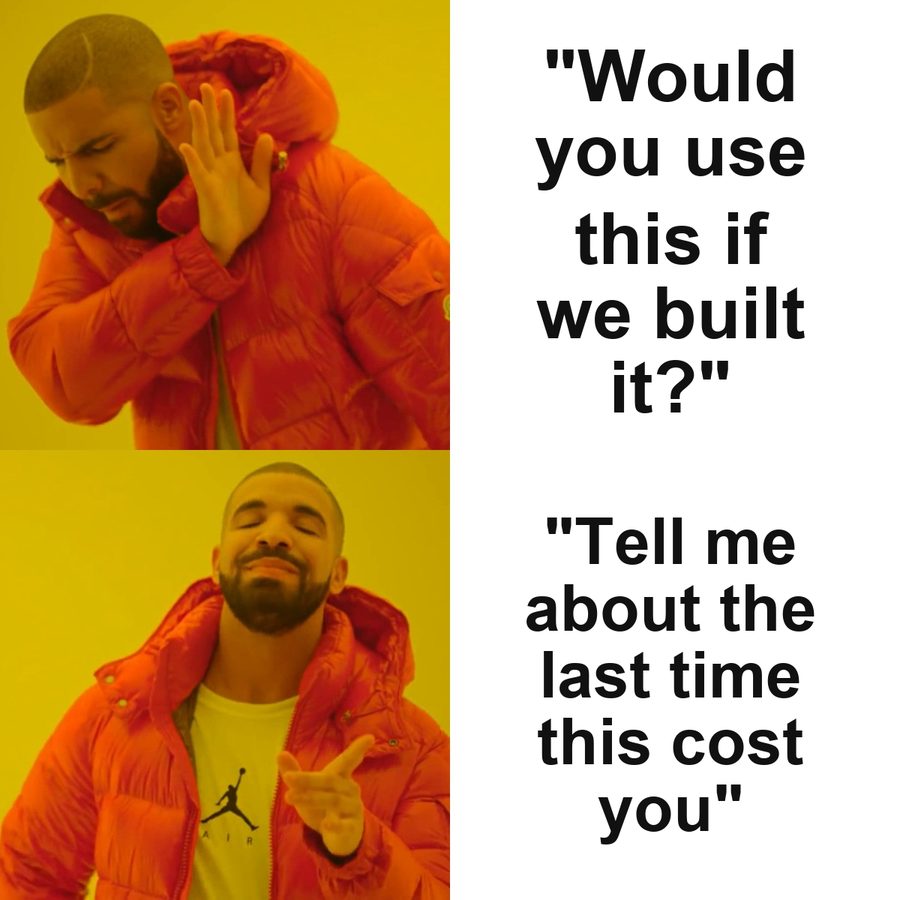
The rookie mistake, Vishnu said (and he admitted making it himself), is to ask future-facing questions. "Would you use this?" "If I build it, will you pay?" People are nice. They say yes. They will even sign up if you persist. None of that is evidence. It is opinion.
The real tests, in order of strength:
- Did they pay?
- Are they paying repeatedly?
- Did they refer friends or family?
He called this "selling diamonds versus selling diapers". There is room in the market for both. You can build a real business selling diamonds, where people pay occasionally for something valuable. But diapers, bought again and again, are an even stronger signal that the problem is real.
Instead of "would you", ask about the past. His validation slide put the whole script on one page, and it is the single slide from the week I would print and tape above a desk:
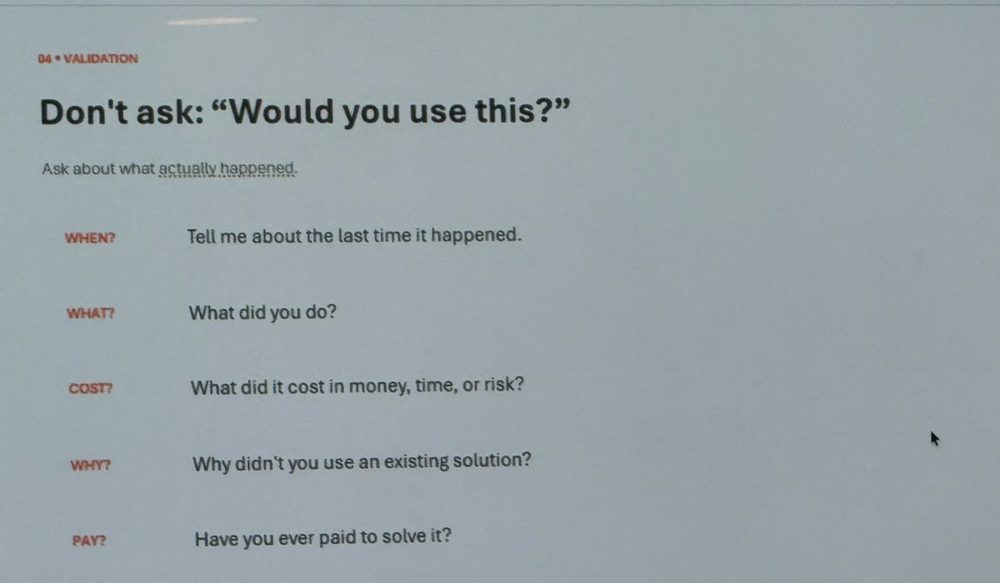
- WHEN? "Tell me about the last time it happened."
- WHAT? "What did you do?"
- COST? "What did it cost in money, time or risk?"
- WHY? "Why didn't you use an existing solution?"
- PAY? "Have you ever paid to solve it?"
The five labels are a useful memory aid in the interview itself. If you walk out and cannot fill in all five for that person, you had a pleasant conversation, not an interview. The order matters too: WHEN anchors the person in a real, specific episode, so that everything after it is memory rather than imagination.
The answers tell you who your early adopters are. If someone says "I used an existing solution and it was good enough, I'm super busy, it didn't cost me much, I'd rather hire another junior than pay you," that is not a rejection. That is data. It tells you this person is not in your first hundred.
Observe behaviour. Not estimated behaviour or expected behaviour, because nothing about the future is guaranteed.
- Vishnu Chundi
I admitted in the room that we had missed two of those questions in our own interviews: the cost in money, time or risk, and whether they had ever paid for a fix. We had been asking people whether they liked the product. We had not been asking what the problem cost them the last time it bit. If you run customer interviews, check your own script tonight. I would bet most founders have the same two gaps.
Vishnu's goal for all of us: find the first 100 buyers who score high on pain, high on frequency and high on economic consequence. "If you identify those people, then you will be saving yourself a lot of time and energy."
Find the one assumption that kills you
Next, assumptions. Every startup is built on a pile of them: customers have the problem, they will pay, and the big one, they will switch behaviour. He used the humanoid-robot bet as a tangent. Labour is a huge share of global GDP, so it is a fantastic target in theory. But will a household or a business switch from a person on a monthly wage to a robot? Switching cost is where hypotheses go to die.
The exercise:
- Write down all your assumptions, internal (team, product, tech) and external (market, regulation, distribution).
- Circle the one assumption that could literally kill the company.
- Then do a pre-mortem.
A pre-mortem, not a post-mortem: behave as though the company has already died, and write the report on why. He warned it can be infuriating, because it forces you to face blind spots. We all suffer from confirmation bias. We look for information that confirms what we already believe, the same way people defend their cricket team. We are emotionally invested, so we skip the negatives.
One risk at a time, almost binary
Someone asked a sharp question about thresholds: if you run a test, what pass rate counts? Is 50% enough, or do risky assumptions need 80%? Vishnu's answer surprised me. Don't test multiple risks at all. At this stage your advantage is speed, so pick the single assumption that turns the product into a zero, define success clearly, and treat the result almost as a 1 or a 0. Where exactly the bar sits is partly founder instinct.
His example of a true company-killer was the App Store. People were building apps before it existed and could not sell much, however sophisticated the apps were, until Apple created the distribution. So ask: what is outside your control tomorrow? If that tap turns off, is it game over? For many startups the answer is a platform, a regulator, an integration partner or a single distribution channel.
Argue for killing your own startup
He ended this block with a fun, brutal exercise: each of us had 30 seconds to argue why our own startup should be killed. The answers, kept anonymous, contained three lessons worth generalising.
- "We can build it in-house" is a signal, not an insult. A software founder said the objections they hear most are "an LLM can do all of this", "we already have people for this" and "our tech team can build it in-house". Vishnu called that dangerous territory: high switching cost and existing tools that sort of work. The exercise forces you to answer the next question yourself: why not kill us? What is the defensible edge? Sometimes, he said, the honest answer is that there isn't one, and it is better to pivot now than to discover it in three years.
- A threat can become a platform. A founder named a future technology that could replace their whole category, but said it was a decade away. Vishnu pushed back on the timeline, and then offered the useful reframe: if that assumption comes true, can you build on top of it instead of being replaced by it? A killer assumption, examined, can become a new direction.
- Precision about the customer changes everything. In a rental hosting business, is the customer the property owner or the host who leases and runs the properties? The owner may get fixed rent and have no reason to care about occupancy. The pain, and the budget, sit with the host. "At this level, the precision really matters."
Meet the saboteur
When a B2B security founder described selling to security heads at large companies, Vishnu introduced a character I had never heard named: the saboteur. In many enterprises, someone in procurement or IT is effectively rewarded for explaining why the company should not buy third-party software. They may even take meetings to learn from you and then say no.
He added a point about trust that I keep thinking about. Founders play by the rules of quantum physics: asymmetric bets, huge upside. A senior buyer at a big company plays by classical physics: if they put their name behind a small vendor without certifications and it goes wrong, they can lose their job. They get no reward for risk-taking. A strong board of advisors or a credible founding team can partly make up for a lack of operating history, though he was honest that it isn't a cure-all.
The practical move: for every deal, write down who champions it, who uses it, who pays, and who is quietly safest saying "not yet". If you cannot name the fourth, you have not met them yet, and they are still there.
Define your customer until it hurts
One slide in Vishnu's deck framed this whole section with two photographs: a row of fishing boats and a row of yachts.
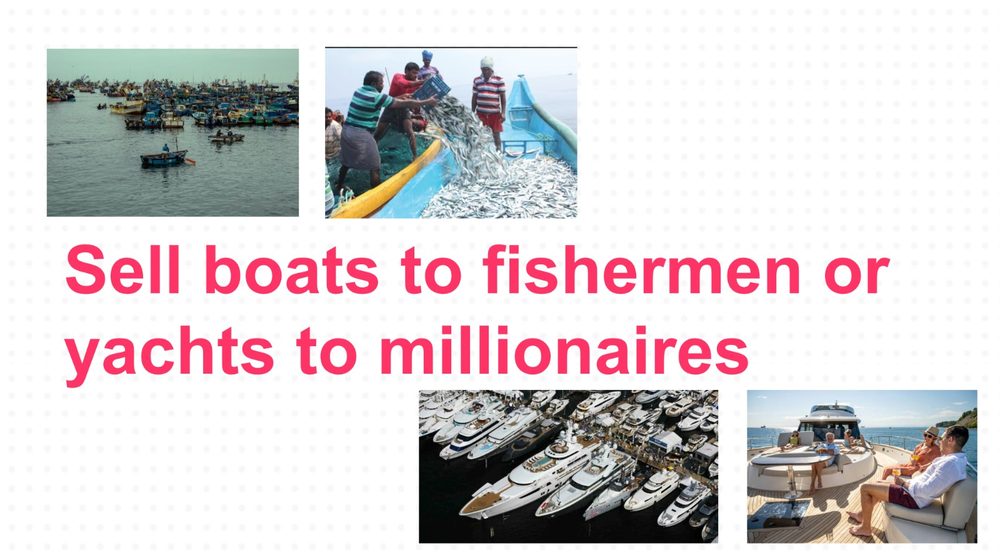
Sell boats to fishermen or yachts to millionaires? Both are boats. Both can be good businesses. But who you sell to decides the business: the price, the sales cycle, the channel, the service, even the kind of team you hire. The fisherman buys a tool that has to pay for itself this season; the millionaire buys an experience and a status signal. If you have not chosen, your product, pricing and pitch will be quietly trying to serve both, and will convince neither. (It also echoed a line from the Day 1 pitch clinic: "We may start as boat people, but we have to be a yacht." You can begin with the fishermen and plan your route to the marina, as long as you know which one you are serving today.)
Vishnu's last big point was about market sizing, and he did not hold back on the classic mistake: "India is 1.4 billion people, so our market is three billion dollars." That is top-down, and most investors now want bottom-up segmentation: can you define specifically who has the problem?
Take any B2B product. You should be able to say:
- the role and seniority of the buyer and the user,
- the size of the organisation, in the units that matter for your product,
- their actual budget for new tools,
- who controls the purchasing decision.
Then keep going: where do these people gather? Is there a club, an association, a conference they all attend every quarter? "That is where you should be marketing." The more precise the customer, the easier it is to test your assumptions and to expand from there.
His credibility checklist for any market thesis:
- Is the problem clearly understood without a long explanation?
- Is the customer precisely defined?
- Is there observed behaviour, not estimated?
- Is willingness to pay demonstrated?
- Can you actually reach them? He called distribution "a very, very important and usually overlooked aspect".
- If all of that checks out, can you expand?
One piece of co-founder advice I liked: play yin and yang. One founder can be the founder-push person, carried away by the vision; the other the market-pull person who keeps asking whether customers are really asking for this. If you are a solo founder, find someone outside the company to play the second role, and give them permission to be annoying.
He recommended four books: The Lean Startup, The Failsafe Startup (on false positives, where talented founders skip validation, get early prototypes working anyway, and fail later), Fall in Love with the Problem, Not the Solution, and Shortcut to Startup, which he said he rereads every three months. He signed off with: "It's a long journey. Stay motivated, take care of your diet."
Five questions every founder should answer
After tea, the second session was framed as a fireside chat but ran as a group conversation. Every founder introduced their startup and stage first, a reminder of how varied the cohort was: defence, cybersecurity, AI research, legal tech, hospitality software, wearables and health.
The panel: Srinivas Kollipara, who founded T-Hub and now runs the ByOom venture studio; Rathnakar Samavedam from Hyderabad Angels; and G. Sravanth, founder of Adonmo, whose screens you have probably seen beside the lift in a gated community.
Srinivas opened with a request I appreciated: "Don't put us on a pedestal. Ask great questions. Don't hide stuff, otherwise we can't help." Then he gave the five questions he asks every founder:
- What problem are you solving?
- Who are you solving it for?
- Why you?
- Why now?
- How do you fit into the competitive landscape?
The first two are a pair. "You change one side of that equation, the other side changes automatically." The same problem for a small company and for an enterprise is a completely different business. On competition, he was blunt: very few of us are doing something that has never been done. We may be doing it differently, and the question is how we fit.
Know what kind of company you are building
He also gave the caveat that rooms like this often skip. Everything under discussion assumed venture-scale opportunities, problems large enough to support a company with potential for very large revenue (revenue, he stressed, not valuation). But that is not the only kind of company worth building. You can form a company around a smaller problem, make a good income and have a good life. "Doesn't mean you shouldn't set up the company. Just be aware of what you're building," and therefore what funding you need, if any. For students and first-time founders especially, this is freeing: not every good business needs venture capital, and not every venture pitch is a good business.
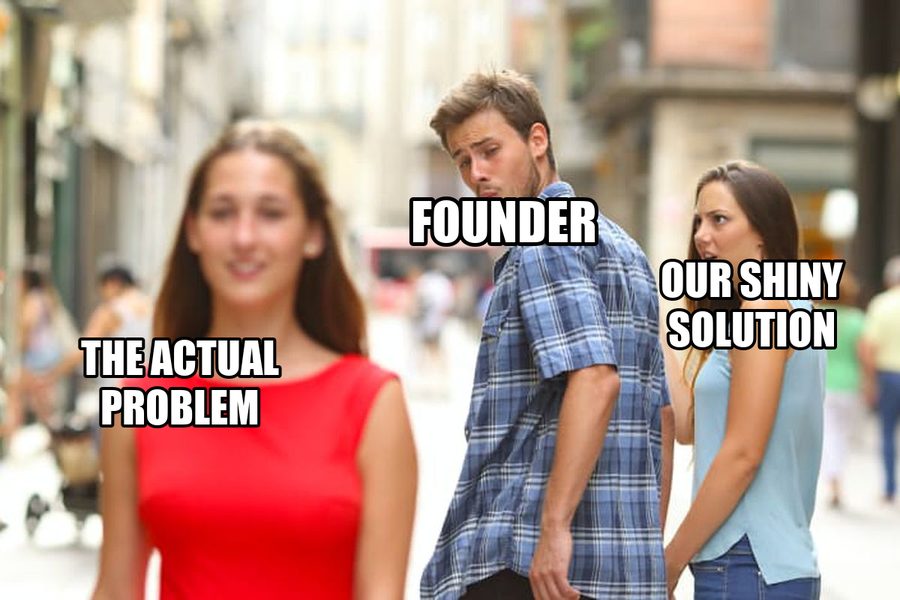
Fall in love with the problem, not the solution
Sravanth told the Adonmo story. He was inspired by the ad displays on top of New York taxis and started with taxi toppers in India. Things were going well until COVID hit, and the company came close to running out of runway. So they went back to the drawing board and asked what problem they were actually solving.
We are not into the taxi topper business. We are into the business of getting brands to reach the right eyeballs.
- G. Sravanth, Adonmo
People were at home, in gated communities, so they moved the screens there. It scaled far better, and they never went back. "Had we been looking at the solution, we would have been stuck with the taxi toppers." It is very easy, he said, to get attached to what you are building and forget what you are solving for.
This is a sentence worth writing for your own company: "We are not in the ___ business. We are in the business of ___." When I tried it on ours, the first blank was our device and the second was giving people their time back. The device is a door. If a better door appears, the business should survive it. If your second blank still describes a product rather than a customer outcome, keep rewriting.
How investors read you
Rathnakar spoke from the investor's chair, and he was direct.
From the VC perspective, I am not looking at your passion. I am looking at your future value.
- Rathnakar Samavedam, Hyderabad Angels
Investors salute founders for their passion, he said, but the investment has to make sense. They look at emerging themes and ask how fast a founder can capture the moment while it lasts. You cannot keep building for too long. How fast can you get to market fit? Who are you betting on, and how do they reach customers?
He shared an observation about the founders he meets: many are not willing to go out and aggressively capture the market, a large group are confused from attending too many events where everyone says something different, and only a small minority have real clarity. "You have to be very clear on your purpose." And don't come in with "partnering" as the objective of the company. Partnering is part of the journey, not the destination.
On money, his message was simple: the market respects revenue and margins again. Move revenue from zero to something real, stabilise, then grow. Don't go blind.
Prove the story, or become a zombie
Srinivas added the counterweight, and I think the two views together were the most useful exchange of the day. Execution matters enormously: "There are 50 people thinking the same thing today, execution separates." But we are also building companies whose story depends on hypotheses about why the market is big and why our product wins.
You will claim something today. You'll build that story out and say, I'm different because of this, this, this. None of it's proven yet.
- Srinivas Kollipara
So isolate those hypotheses and prove them with evidence, so that the next time you raise money the story is backed by data. He has seen founders who focused only on revenue become zombie companies after four or five years: an okay company, a little money, no differentiation. "We're very conservative in India typically. You want to play a bigger game. Can I become a category creator or a category disruptor? For doing that, what do I need to prove?"
In other words: revenue and evidence, both, not either. Revenue proves someone will pay; evidence proves why you will keep winning.
Deep tech de-risks by milestone
For hardware and deep tech at early readiness levels, he said the logic is different. You get backed as milestones de-risk the technology, the way a space company can be ignored before its first launch and suddenly taken seriously after it. The launch, not revenue, was the proof. He also urged deep-tech founders to separate the core technology from its application. Often the first application is the wrong one while the core tech is still valuable, so look at adjacent markets before you give up.
Niche first, think big
A founder building a new kind of AI model asked the question many of us had: when your technology can serve many markets, how do you choose? Should you run small pilots in three verticals at once?
Srinivas described ByOom's process as assess, craft, build. Assess: is the problem big enough, is the team good enough for now? Craft is the part most founders skip: bring the huge thing down to a narrow, manageable scope. What is your early-adopter strategy? What is the one niche that proves your hypotheses?
Three verticals where even the expression of the technology differs is a bandwidth trap. "You spread yourself across everything. You're not learning focused lessons." Someone brought up Henry Ford and Elon Musk as opposite strategies, mass market first versus a luxury sports car first. Srinivas's reply was that both were extremely focused. "Any colour as long as it's black" and a single car for a small set of influential buyers are the same discipline.
And one line I underlined twice: as a startup you will take money from anyone who gives it to you, but ideally pick your customers. Pick the ones who can become champions for the larger story.
The metrics that matter
The founder of a hyperlocal community network asked what investors want to see in a network-effect business that will be loss-making for a while. The panel's answer is a good checklist for any consumer or marketplace founder:
- Repeat rate is the strongest behavioural signal.
- Acquisition cost should come down over time as brand, density and repeat purchases kick in. If it isn't coming down, the model isn't working.
- Lifetime value to acquisition cost is the unit-economics health check.
- Build a three-year construct showing how customer value grows and acquisition cost falls, and what milestone unlocks the next stage.
- A five-year road to profitability is too long for most Indian investors today, and someone with deeper pockets can out-distribute you before then.
- Don't benchmark against Amazon's decade without profits. "That doesn't work for 99% of companies."
Rathnakar added that many investors now look closely at gross margin, and that the question he hears constantly about AI companies is how token and compute costs will come down over time. If you build on large models, "how do you optimise your tokens?" is now a standard investor question, not a technical footnote.
Why now
On timing, Rathnakar walked through how he sees the landscape: defence and drones are hot, space tech is maturing, semiconductors need patient capital, and industrial automation is a big market whose customers are not quite ready. He also said he sees healthcare and genomics as a coming wave, with longevity underfunded today.
The general lesson is that timing can matter more than product quality. "Why now" is not a slide you fill in with a trend report. It is your answer to which specific forces (a regulation, a cost curve, a behaviour shift, a new platform) are opening a window for you right now, and why the window was closed three years ago.
Earning enterprise trust
Towards the end, the conversation turned to selling into large organisations. The question Srinivas put was simple and uncomfortable: when a big customer considers you, how do they know you will be around in twelve months? Team stability and full-time commitment are part of what they are buying. His suggested path: get the product into the hands of any customer you can reach, build certifications, security and compliance at the back end, and approach the bigger systems once you have that confidence.
He also punctured a fallacy he sees often: "I want to sell to the US, so I'll go sleep on my friend's couch in the Bay Area." It rarely works. You need to understand the sales cycle inside a company: the many people who have to be convinced, and the integration cycle with its certifications and security reviews.
Two last prompts from him. On co-founders: if you are both technical, that can work, but think hard about whether you cover each other's gaps. And on segments: people throw around "mid-market" and "enterprise" without defining them. For your company, what actually changes between the customer you serve today and the one you want? The sales process? The stack? The integration? Name it, then work out what you need to win it.
Mafia Night
The day closed with Mafia Night. I won't pretend there was a business lesson in it, except maybe this: the people who talked most confidently were not always the ones telling the truth, and the quiet observers usually worked it out first. After a day of being told to observe behaviour rather than trust what people say, it felt oddly on theme.
Apply it to your startup
- Score yourself honestly, from the user's side. Not how exciting the product is, but how painful, frequent and costly the problem is for the person who lives it.
- Name your status quo competitor. Write down the person, habit or spreadsheet you are really replacing, and what it costs the customer to keep it.
- Audit your interview script. Strike every "would you". Add "what did it cost you last time" and "have you ever paid to fix it".
- Pick one company-killer. Something outside your control that could zero you. Design one test with a clear pass line and run it before building the next feature.
- Draw the stakeholder map for your next deal, saboteur included.
- Write your "not in the X business" sentence and check that the second half is a customer outcome.
- Choose one niche. If you are running pilots in three markets, ask which one proves your core hypothesis fastest, and pause the others.
Resources from the day
People who taught
- Vishnu Chundi, founder of a family wealth-transfer company: workshop on defining the real problem and the riskiest assumption (deck: "Map the Terrain").
- Srinivas Kollipara, founder of T-Hub, now running the ByOom venture studio.
- Rathnakar Samavedam, Hyderabad Angels.
- G. Sravanth, founder of Adonmo.
Frameworks
- Pain × frequency × consequence, each scored 1 to 10 and multiplied.
- The five past-facing validation questions: WHEN, WHAT, COST, WHY, PAY.
- The evidence ladder: paid, paying repeatedly, referred others.
- Assumption list, one company-killer, pre-mortem, cheapest fast test.
- The enterprise stakeholder map: champion, user, payer, saboteur.
- Srinivas's five questions: what problem, for whom, why you, why now, where you fit.
- ByOom's assess, craft, build.
- "We are not in the ___ business. We are in the business of ___."
- Boats to fishermen or yachts to millionaires.
Quotes on the slides
- Helmuth von Moltke: no battle plan survives contact with the enemy.
- Steve Blank: no business plan survives first contact with a customer.
Books Vishnu recommended
- The Lean Startup (Eric Ries)
- The Failsafe Startup
- Fall in Love with the Problem, Not the Solution
- Shortcut to Startup
What to take away
- Every startup is a hypothesis; your job is to find out what is true, fast.
- Value is pain × frequency × consequence; a zero anywhere kills it, and consequence is usually the weakest-researched factor.
- Your real competitor is the status quo, the cheap arrangement that already sort of works.
- Opinions are not evidence. Payment, repeat payment and referrals are.
- Ask about the past, never the hypothetical future.
- Find the one assumption that can kill you and test it first, almost as a 1 or a 0.
- Every enterprise deal has a champion, a user, a payer and a saboteur.
- Define your first hundred customers precisely enough to find them in an afternoon.
- Fall in love with the problem; the product is only the current door.
- Investors want both revenue and evidence that your story is true, or you risk becoming a zombie company.
- Start in one niche, pick customers who can champion the bigger story, and know your "why now".
Try this
- Score your problem. For your top customer segment, rate pain, frequency and economic consequence from 1 to 10. Multiply. Write one sentence on which factor is weakest and what evidence would raise it.
- Rewrite your interview script. Delete every question that starts with "would you" or "if we built". Replace them with Vishnu's five past-facing questions. Run three interviews this week with people who are not friends or colleagues.
- Run a 15-minute pre-mortem. With a co-founder or another founder, write your company's obituary two years from now. List every cause of death. Circle the one outside your control that would take you to zero, and design the cheapest seven-day test for it.
- Draw your stakeholder map. For one real deal, name the champion, the user, the payer and the saboteur. If you can't name the saboteur, you haven't met them yet.
- Finish the sentence. "We are not in the ___ business. We are in the business of ___." Rewrite until the second blank describes the customer's outcome, not your product.
- Define your first 100. Write the exact profile of your first hundred buyers (role, organisation size, budget, where they gather). If you can't find ten of them in one afternoon of searching, your customer definition is not specific enough yet.