Day 10 · Sharpen the pitch, protect what you own
By Karthik Nagapuri · 2026-09-23 · Draper Founder Program #2
The day before Demo Day as a founder's playbook: partners over direct sales in slow B2B, Aaliyah's rules for ordering a four-minute pitch, the case for a memorised script, and Aditya Saha's workshop on what a startup actually owns and how to protect it.
Wednesday was the day before Demo Day, and it felt like it. Decks were due to the organisers that night, founders were rehearsing in corridors, and every conversation seemed to end with someone saying "that's too long." The day had five parts: a morning pitch to a mentor who knows slow enterprise markets well, a one-to-one deck review with Aaliyah from Draper, a long workshop on trademarks and patents that I think every founder in India should sit through, an afternoon session rebuilding a pitch from scratch, and a short evening chat with a student founder whose answer to one question stayed with me all night.
The thread running through all of it: clarity is a form of respect for the person listening. And, from the afternoon workshop, a second thread I did not expect: most early founders do not actually own the things they think they own.
This chapter is organised as lessons, so you can lift any section into your own week.
The day's programme
- 10:00–11:00: Session with Sunil Potturi.
- 12:00–1:00: Patents, trademarks and IP, with Aditya Saha.
- 2:00–3:00: Session with Patankar.
- 6:00–7:00: Session with Suryakant.
- Through the day: one-to-one pitch and deck reviews with Aaliyah (Draper), team by team.
- Also on the programme: a session on grants.
Not every session was recorded on our side, so the lessons below follow the conversations I have notes for. Where I cannot be sure which listed speaker led a conversation, I describe them as a mentor rather than guess.
Sell through partners when B2B gets slow
We opened by pitching a mentor with deep experience of Indian healthcare. We were promised two to three minutes. It went to ten, which, as Piyush joked afterwards, happens every single time we sit down with someone for five. The conversation turned into a masterclass on getting into markets that do not want you.
Nobody wants a new vendor
His diagnosis of enterprise sales was sobering, and it applies well beyond health.
B2B has become brutal. You should end up having more partners than customers.
- A mentor, on enterprise sales in India
His point was that enterprise sales cycles in many sectors now run two hundred to three hundred days. Buying has become relationship-driven, and organisations are drowning in startup pitches. Nobody wants a new logo in their vendor list, and no end user wants one more app on their phone. So get through the door any way you can, and that usually means a partner who is already inside: the software platform the customer already uses, the distributor they already trust, the consultant they already pay.
When we asked what single thing to accelerate right now, he said "partners, partners, partners". Three times.
Plug in, do not replace
This fits a decision many founders face: build the whole system, or plug into the one the customer already has? Switching core software takes enormous trust and means redesigning a whole workflow. In our case, we had stopped building our own hospital management software for exactly this reason and chose to go in as a plugin to the platforms hospitals already use, borrowing their distribution. The mentor agreed strongly. The general rule: if your customer's biggest fear is change, make your product the smallest possible change.
The rest of his checklist
- Get your licensing done early. In any regulated sector, the product lives or dies by regulation. Start the paperwork before you think you need it.
- Listen to what the market says about your pricing. Do not fall in love with a number.
- Go where the need is rawest. He suggested spending three or four days in rural settings, letting users there try the product, and coming back with evidence. There is real appetite among investors and funds for products that serve underserved users, and a founder who can show it working there has a different story to tell.
- Talk to the person who answers the phone at night. A salaried employee at a big institution may not take your call at 9 p.m. The owner of a small practice will. That is where ground-level truth lives.
- Watch the competition, always.
Why hardware, why now
He also asked the question every hardware founder hears: why a device and not just an app? Our answer has sharpened over these ten days, and the shape of it works for any "why now" argument:
- Friction. A general-purpose device (a phone, a laptop) gets forgotten, moved or used for ten other things. A dedicated device does one job.
- The convenience trap. Software was easier to deploy and scale, so everyone built software. Hardware means R&D, manufacturing and supply chains, so most people avoided it. That avoidance is an opening.
- The first wave came too early. An earlier generation of products arrived before the enabling technology was good enough. Now it is.
- The bar is different. In high-stakes settings "right half the time" is failure. Meeting that bar takes research, which is itself a moat.
If you are building in a space where someone failed before, this four-part structure (friction, what everyone avoided, what changed, why the bar is higher) is a good template for your contrast slide.
Sell a different thing to each person
The part of the pitch that landed best was separating value by stakeholder, which echoed the previous day's messaging workshop.
For us, the user wants less paperwork, the owner wants a specific business metric to move, and the end customer wants reassurance after they leave. A hypothetical B2B payroll startup might sell time to the HR team, compliance to the CFO and on-time pay to employees. Same product, three sentences.
Right after the session came an announcement: pitch decks for Demo Day were due that night. Someone asked whether the deadline was 9 p.m. or 3 a.m. Nobody was entirely sure. We assumed the earlier one.
Order the story: context before traction
Late morning, Aaliyah from Draper sat each team down for a one-to-one run-through. The brief was simple: pitch as if it were Demo Day, do not go over four minutes, and simplify the things you think you need to talk about. She warned us she was being harsh, and added that Indian investors would probably be harsher. It was the most precise deck feedback of the week, and nearly all of it generalises.
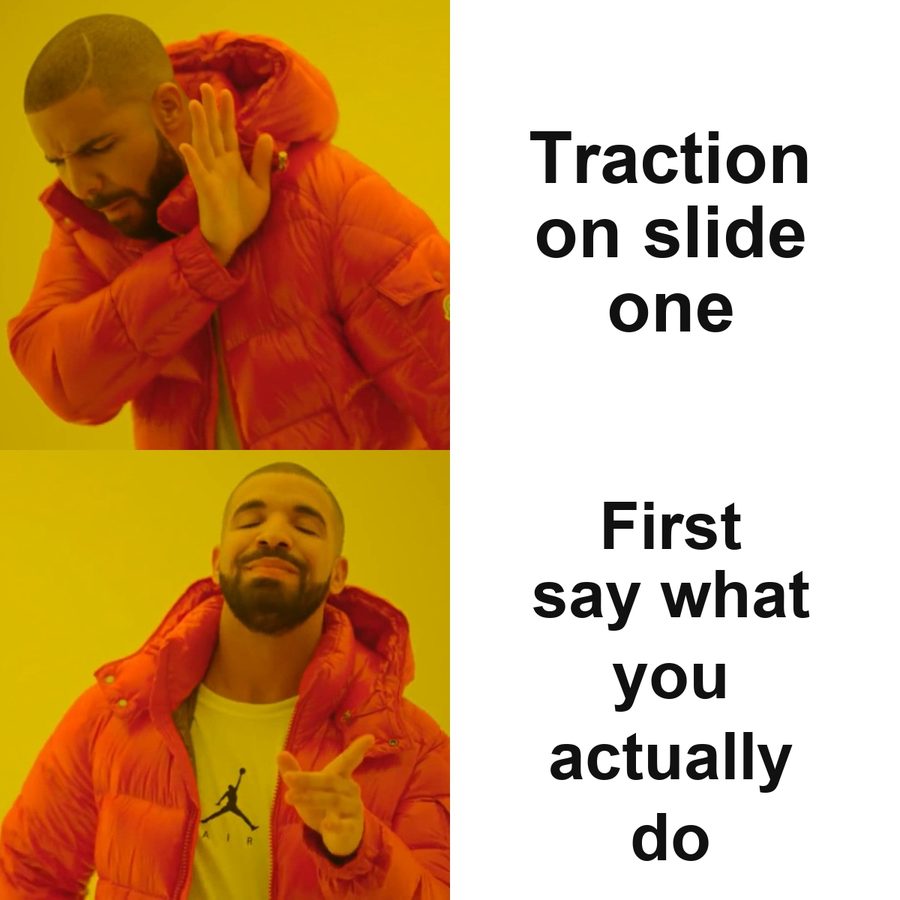
Do not open with traction
Many founders are told to put traction on slide one because it grabs attention. We had done exactly that. Aaliyah disagreed.
Your traction means more after I know what you're doing.
- Aaliyah, Draper
Her example: if someone opens with "we have eight thousand people on the waitlist," the listener immediately wonders, a waitlist for what? A newsletter? A physical product? Numbers mean nothing without context, and an investor hearing your pitch for the first time starts from a blank slate. They are used to a certain sequence, and a curiosity trick may just confuse them.
Repeat the numbers at the right moment
She still wanted a dedicated traction slide later, because she had heard our numbers twice and had already forgotten them. That sounds strange until you remember investors hear hundreds of pitches a month. Say it at the right moment, even if you said it before.
The four things that matter
In a short pitch, she said, four things matter and everything else matters much less.
Three numbers, one problem slide
It is tempting to build the problem section into a long, emotional story, often borrowed from statistics in other countries. Aaliyah asked us to cut ours. What had stuck with her from the day before were just two numbers about the local market, and those two made the problem visible and hinted at the market size at the same time.
Her rule: three local numbers, no more. When Piyush tried to add a fourth, she said no. Three is enough. A founder in any sector can apply this: pick the three numbers from your own market that make the pain undeniable, and cut the rest.
Explain competition as a history of failure
She liked one move in particular: explaining competitors by saying why earlier approaches did not work. For each alternative, one line on the friction it created, then your product as the lowest-friction answer. In our case that was screens that pull attention away, glasses that make people self-conscious, and a small clip-on device with zero behavioural change. The structure is what matters. "Here is what was tried, here is why it stalled, here is why we do not" is more convincing than a feature grid with ticks in every one of your columns.
She also told us to keep a creative framing slide we had, a short visual history of how the field's tools evolved, ending with ours. A good framing slide makes the investor feel your product is the obvious next step.
Two slides for the product, and no robot
Our product section had four busy slides. Her suggestion was beautiful in its simplicity. Slide one: a real photograph of the product in use, in its real setting. One sentence. Slide two: the output it produces, with the human approval step. Done.
When we suggested adding an AI assistant character to show the "intelligence", she was firm. No virtual person, no friendly robot. Keep it real. If your product is software, the equivalent is a real screenshot of a real workflow, not an illustration of a glowing brain.
The Shark Tank rule
Then came the advice I found hardest to accept and most useful.
Those people that go on Shark Tank do not wing it. They have a word-for-word memorised script, literally down to the word.
- Aaliyah, Draper
Her reasoning: when you are pitching live, you see things on your slide you were not planning to say, and you start adding them. That is what makes a four-minute pitch take six. A memorised script is not stiff. Nobody needs to know it is memorised. It just stops you rambling about random things on the slide.
A few more rules from her:
- Slide count does not matter in a timed pitch. Time per slide does. A slide where you say one sentence is fine.
- Two sentences per slide. Three on a few, at most.
- Everything else goes to the appendix. Unit economics, roadmap, extended product pipeline, the design-heavy mission slide. Pull them up in Q&A if asked.
We walked out with a to-do list that was mostly deletions. I suspect that is true of most pitch reviews.
Protect your brand: what a trademark really does
Around midday the cohort had a long workshop on patents, trademarks and IP with Aditya Saha, an intellectual property attorney who has spent a career filing trademarks and patents for clients ranging from local food brands to large developers and film production houses. It ran well past its hour. I filled more pages in this session than any other this week. Here is the structured version.
How strong is your name?
Names sit on a scale from weakest to strongest:
- Descriptive names (weakest) describe what you do. Hard to register, hard to defend. Avoid quality words too, like "Best", "Super" or "A1", and names of gods, because everyone uses them.
- Suggestive names hint indirectly. Jaguar suggests speed, which suits a car.
- Arbitrary names are real words with no link to the product. Amazon is a river. Apple is a fruit.
- Coined names (strongest) mean nothing until you give them meaning. Zomato, Google, Adidas. Nobody wants to copy them early, and there are few disputes later.
The room was tested with a list of made-up brand names: pick the strongest. The descriptive ones felt friendlier, and several people picked them. The point: descriptive names have low recall and are very hard to defend. And changing the spelling does not save you. "QuickClick" spelt "Kwiklek" is still phonetically the same, and phonetic similarity is what examiners look at.
More than a word: kinds of marks
It was eye-opening how much can be protected:
- Letters (KFC), numerals (7-Eleven), phrases and taglines ("Just Do It", "Have a break, have a KitKat").
- Sound marks (the Britannia jingle), pattern marks (the Louis Vuitton monogram), shape marks (the Toblerone triangle).
- Packaging designs, with each iteration filed separately if you want complete protection.
- Word marks and logos, filed as two separate applications. Word marks, in plain type with no styling, are harder to get and more valuable.
On symbols: TM means you have filed, R means registered, and SM (a service mark) is mostly used in the US. If you are using R on a mark that is not yet registered, remove it.
Classes: protect where you might be copied
All goods and services are divided into forty-five classes: 1 to 34 for goods, 35 to 45 for services. The most common founder mistake, we were told, is filing in one main class and thinking you are protected.
The worked example was a construction company. A good attorney would not stop at the construction class, but add real estate, advertising and marketing of projects, cafés and canteens (buildings often have one with the same name), and mobile apps: at least a dozen categories for proper protection. The question to ask is not "what do we do today?" but "where could someone ride on our name?"
For a typical tech startup, the suggested starting set:
- Class 9: software products, electronics and devices.
- Class 42: software development, AI, new product development.
- Class 45: if you plan to license your technology.
And if your product brand differs from your company name, protect both, the way a large conglomerate protects the parent name and every sub-brand.
Three things that are not ownership
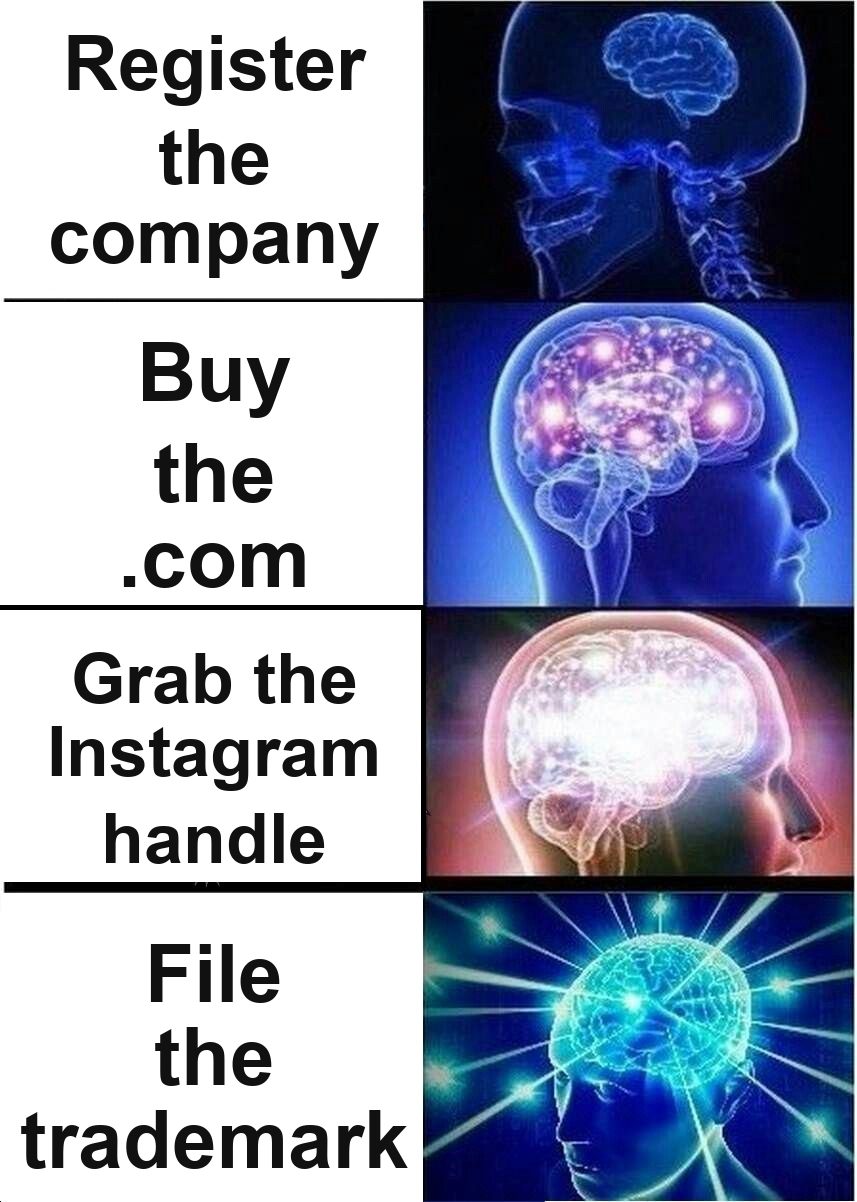
This was the slide that made the room go quiet.
- Your company registration. The registrar will happily register companies with very similar names in other industries.
- Your domain. It is an address, not ownership. Someone else can register the same word with another extension.
- Your social media handle. Someone can add two letters and open a near-identical account.
The summary was blunt: a trademark is the ultimate protection for your brand. And it is not just theory. With a registered certificate, marketplaces, video platforms and domain dispute bodies will act on a complaint. Without one, they will say "we are looking into it" and never do anything. Then came stories of trademark squatting, including someone who had registered the name of a famous gaming console in India long before its maker arrived, which delayed its launch here by about a year.
Objections and proving prior use
Almost every application meets one of two objections: a similar mark already exists, or your mark describes your product. If you were using a name commercially before someone else filed, you can argue prior use, but you have to prove it:
- Invoices with your logo and a date, ideally issued digitally so the timestamp cannot be changed. Genuine handwritten invoices from a solo founder's early days still count.
- Dated social media posts showing the brand.
- Volume. Aditya once won a case for a descriptive name by showing the examiner a huge stack of invoices proving how widely the brand was used.
The monitoring routine is worth copying: a weekly automated search for any new filing that shares a few letters with your mark, then a human check for phonetic similarity. For founders without a firm, at least a monthly search on your own name and close variants.
Timelines, costs and going abroad
- A trademark lasts ten years and can be renewed indefinitely, with a grace period after expiry.
- In India, a normal application takes around two years to acceptance, then a mandatory four-month window for opposition. An expedited route gets acceptance in a few months, followed by the same four-month window.
- There is no global trademark. You file country by country. The Madrid Protocol lets you cover many countries in one application, more cheaply but more slowly. Filing directly in a country is faster and costs more. India is one of the most economical places to file. The UAE is among the most expensive.
- Startup India schemes can reimburse some filing costs, and DPIIT recognition can reduce fees, though claiming reimbursements takes patience.
Protect your inventions: file before you talk
The patent half of the workshop had one message, repeated until it stuck.
File a provisional from day one, even before going out for pitching.
- Aditya Saha, IP workshop
How the clock works
- A patent protects for twenty years, with annual renewals that get more expensive over time.
- A provisional application gets you a filing date. You then have twelve months to file the complete application, or the provisional is abandoned.
- If you want protection abroad but have not chosen countries, file a PCT application within those twelve months, which buys you roughly eighteen more months to decide.
Absolute novelty: your own post can sink you
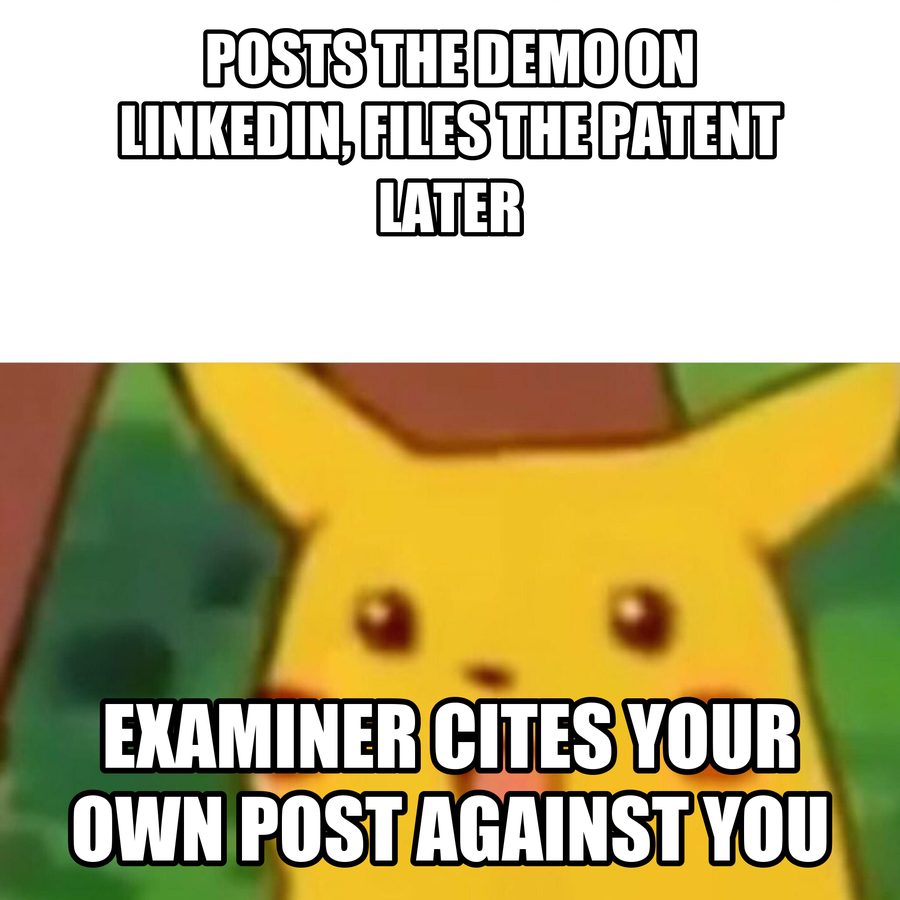
India and Europe follow absolute novelty. Anything published before your filing date counts against you, including your own blog post, paper, demo video or pitch. The US gives a twelve-month grace period. India does not. If you have already published something about the core invention, take it down, file, and then put it back up.
This is the rule most likely to catch an enthusiastic founder. We are all told to build in public. Build in public, by all means, but file first.
What you cannot patent in India
A pure business idea, software on its own (you need to show a technical effect, usually with hardware), and diagnostic methods. A doctor checking a pulse cannot be patented, but a new machine that does it can. If you are a software founder, the question to take to an attorney is: where is the technical effect in what we built?
Papers give credit, not ownership
A founder asked whether publishing research papers on their algorithm would help with credibility. The answer: a paper gives you only moral rights, the credit of authorship, not ownership. Protecting an algorithm needs a careful workaround, which deserves its own session. If you come from research, this is worth knowing before your next conference deadline.
Who owns what your team builds
This one is easy to fix and dangerous to ignore:
- Employees: the company owns what they build only if the employment contract has an IP assignment clause.
- Freelancers and agencies: you get the product you paid for, but the rights stay with them unless they sign a separate assignment.
We were asked to pull out every contract we have signed, or are about to sign, and check for that clause.
Why bother: intangibles compound
The workshop closed on the idea that intangibles compound. A trademark is worth little on day one and more every year it is used, and European Patent Office research was cited suggesting startups that hold patents and trademarks are worth considerably more. We left with a self-assessment checklist to complete within seven days. "Everyone every day is creating something," Aditya said. "We just don't value it."
Reflection
I walked in thinking IP was something you deal with after a funding round. I walked out realising that three of the things we most rely on (our name, our demos, our contractors' work) were only as safe as paperwork we had not finished. None of it is expensive in India compared with most countries. It is just easy to postpone. The asymmetry is the lesson: an afternoon of filing now versus a year of dispute later.
Rebuild the pitch around outcomes
Late afternoon we sat with another mentor to prepare for Demo Day. He began with a question I now want to ask before every pitch: what outcomes do you want from tomorrow? Not the pitch, the outcomes.
Three outcomes, then work backwards
Most founders can name three. Ours were access to a network of potential customers, early backers who believe in the direction, and guidance from people who have done this before. Yours might be a hiring lead, a design partner or a press mention. The point is that everything in the four minutes has to serve those outcomes. If a slide does not, cut it.
Position broad, start specific
We had been stuck on whether to tailor the pitch to Indian or overseas investors. His answer untangled it for everyone in the room: do not tailor it to either. Say what you are, in a category with no regional boundary, and then say where you start and why (usually because the problem is most acute there and your network is there).
The context point was still real. Local investors already know the ground reality in their bones, so the problem slide can be short for them. Someone from another market may need more. Be ready to expand the problem for anyone who needs it, and to skip ahead for anyone who does not.
And the vision should fit in two lines. When Piyush started expanding on future products, the mentor gently stopped him. Two lines.
Script or no script?
Some founders are dynamic speakers. They read the room, stretch the problem if the listener looks puzzled, jump to the solution if they nod. Aaliyah's advice to memorise word for word can feel like a cage to them: what if I skip one line and lose the thread?
The mentor's answer bridged both views. Write a full script so the essence is locked in. Practise until you are confident. Then present as dynamically as you like.
Even if you forget something in the script, it's only you who knows that you forgot it.
- A mentor, during Demo Day prep
His rules for the day before
- Practise to three minutes for a four-minute slot. You will always run about thirty seconds over. Build that in.
- Run your script through an AI and ask: am I repeating myself? It saves seconds and stops the listener feeling it is repetitive.
- If you remove a slide and the story still works, remove the slide.
- A slide should never make the audience choose between reading and listening. It should make what you say clearer, never compete with it.
- Test on a layperson. Pitch to someone outside your field and ask afterwards: did you listen to me or read the slide?
- Research the room. Ask the organisers who is attending and read up on each investor.
- Every number must survive a Google search. If a national average and a city figure differ, pick one, cite it, and know which you picked.
One page or five slides?
Piyush floated ditching the deck for a single pictorial page. The mentor said that can work for a three-minute pitch, with one caution: people explore whatever is on the screen. Unless you actively guide them, they will be reading the traction corner while you are explaining the problem.
We settled on at most five slides, a shape I think works for many short pitches:
- An opening image that says the sector and the product before a word is spoken.
- The team, because it gives credibility to everything after.
- The problem, with three local numbers.
- The solution, with the "why earlier attempts stalled" comparison.
- A closing visual with the product and brand, which stays on screen through Q&A.
If you have a physical product, show it live. A founder wearing or using the thing on stage does more than any render.
The best line of the afternoon came from Piyush, thinking aloud about why he wanted fewer slides: the deck can be made by anybody, so do not look at it, look at us. A pitch deck is a document you send. A pitch is a performance you give. They are not the same object.
A name with a story
The last conversation of the day was with a student founder in the cohort, in his final year of university, building an autonomous drone-detection system that fuses several sensors with a decision layer that classifies what it is looking at in a fraction of a second.
Someone interrupted to ask why his company is named after a number. Why that number, and not another?
He had an answer ready. The number is a line of longitude, and the ring it traces passes near the regions he wants to serve. The name is his origin story and his market map in one.
After an afternoon of learning that coined names, meaningless until you give them meaning, are the strongest trademarks, it was lovely to see the other half of that lesson in person. A strange name is legally strong. A strange name with a story is memorable.
Apply it to your startup
- Map your partners. List every company that already sells to your customer and could carry you in. For B2B in slow markets, this list matters more than your lead list.
- Reorder your deck. Problem, solution, traction, team, then market. Move traction off slide one unless the listener already knows what you do.
- Write the script. Two sentences per slide, timed to three minutes for a four-minute slot. Memorise the essence, then perform it.
- Audit your IP. Name, product names, tagline, logo, designs, inventions, contracts. For each: filed, registered, or nothing.
- Freeze public disclosure of anything patentable until a provisional is on file.
When we did this for our own pitch, the deck lost more than half its slides and gained a clearer story. The IP list was more humbling: several items in the "nothing" column.
Resources from the day
- People on the programme: Sunil Potturi; Aditya Saha (patents, trademarks and IP); Patankar; Suryakant; Aaliyah (Draper), who ran the one-to-one pitch reviews.
- Pitch frameworks: problem, solution, traction, team, then market; context before traction; three local numbers on the problem slide; competition as a history of why earlier attempts stalled; the "why now" template (friction, what everyone avoided, what changed, why the bar is higher); the five-slide short pitch; outcomes first, then work backwards.
- Delivery rules: a word-for-word script (the Shark Tank rule), two sentences per slide, rehearse to three minutes for a four-minute slot, test on a layperson.
- Trademark concepts: the name-strength scale (descriptive, suggestive, arbitrary, coined); kinds of marks (letters, numerals, taglines, sound, pattern, shape, packaging, word mark and logo); the forty-five classes, with Classes 9, 42 and 45 as a tech starting set; TM, R and SM; objections and proof of prior use; the Madrid Protocol for multi-country filing; Startup India and DPIIT fee support.
- Patent concepts: provisional, complete and PCT applications and their clocks; absolute novelty in India and Europe versus the US grace period; what India will not patent; moral rights versus ownership for papers; IP assignment clauses for employees and freelancers.
- Research cited: European Patent Office work on startups that hold patents and trademarks.
- Tools mentioned: the trademark register search for phonetic look-alikes; an AI assistant to flag repetition in a pitch script; the IP self-assessment checklist handed out in the workshop.
What to take away
- In slow B2B markets, partners before customers. Nobody wants a new vendor.
- Make your product the smallest possible change to the customer's world.
- Context before traction. Numbers only impress once people know what they are counting.
- Four things matter in a short pitch: problem, solution, traction, team.
- Three local numbers are enough for a problem slide. Cite them.
- Explain competition as a history of why earlier attempts stalled.
- Show the real product in its real setting. No robots.
- Script the essence, rehearse it to under time, then perform it live.
- A company registration, a domain and a handle are not a trademark.
- File in every class where someone could ride on your name, and file word mark and logo separately.
- In India, your own demo can destroy your own patent. File a provisional first.
- Check every employment and freelance contract for an IP assignment clause.
Try this
Outcomes first. Before your next pitch, write down the three outcomes you want from that room. Delete any slide that does not serve at least one of them.
The blank-slate test. Read your first slide aloud to someone who knows nothing about your company. Ask what they think you do. If they cannot say, your traction does not belong there yet.
The three-number problem. Rewrite your problem slide with exactly three numbers, all from your own market, each with a source you could show on your phone.
The two-sentence script. Write your pitch with two sentences per slide. Time it. Cut until it runs to three minutes for a four-minute slot. Then ask an AI to flag repetition.
Your IP inventory. List your company name, product names, taglines, logos, designs and inventions. Mark each as filed, registered or nothing. Note the classes where someone could copy you, and search the trademark database for phonetic look-alikes.
The disclosure audit. List every public post, video, demo and paper that describes how your product works. If any describe an invention you have not filed for, decide this week whether to file a provisional or take it down.